












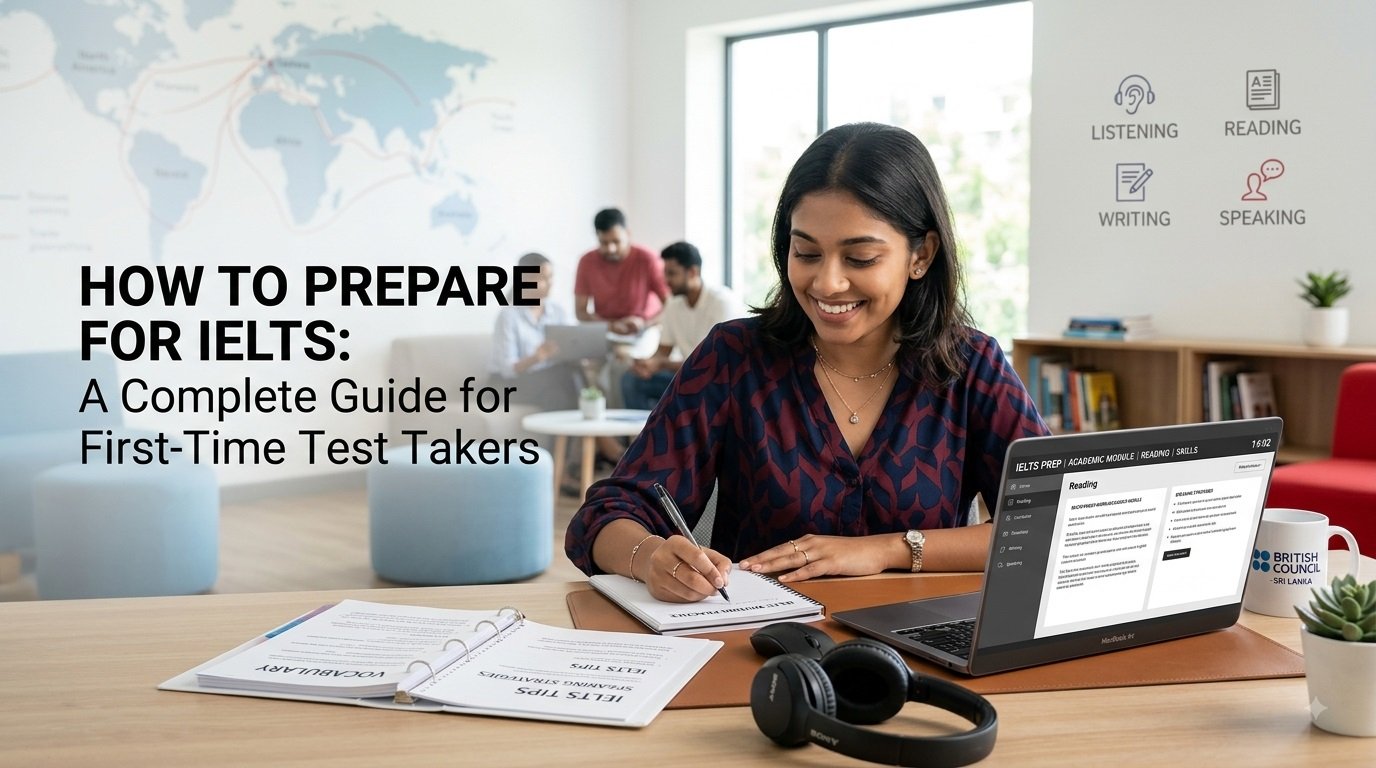
Preparing for the IELTS test for the first time can feel challenging, especially when you are unsure where to begin. The good news is that with the right preparation, a realistic study plan and regular practice, you can approach the test with greater confidence.
Whether you need IELTS for higher education, employment, migration or professional development, understanding the test and preparing strategically can make a significant difference.
What Is IELTS?
The International English Language Testing System (IELTS) is one of the world’s most widely recognised English language proficiency tests. It assesses your ability to communicate effectively in English in real-life academic and professional situations.
IELTS evaluates four key language skills:
Listening
Reading
Writing
Speaking
The test is available in different formats depending on your purpose, with IELTS Academic generally designed for higher education and professional registration, while IELTS General Training is commonly used for work, migration and other purposes.
Before you begin preparing, make sure you understand which IELTS test you need.
Understand the Four IELTS Skills
A strong IELTS preparation plan should give attention to all four components of the test.
1. Listening
The Listening test measures how well you understand spoken English in different situations. You may hear conversations, interviews, discussions and presentations.
To improve your listening skills:
Listen to English regularly rather than only during study sessions.
Become familiar with different accents and speaking styles.
Practise identifying key information and specific details.
Pay attention to spelling when writing answers.
Use practice tests to become familiar with the question formats.
The goal is not simply to understand every word. Instead, learn to listen for the information required to answer the question.
2. Reading
The Reading test assesses your ability to understand written information, identify ideas and locate relevant details.
Develop the habit of reading English every day. You can use newspapers, magazines, educational websites and other reliable English-language materials.
Practise:
Skimming a passage to understand its overall meaning.
Scanning for specific information.
Identifying keywords and synonyms.
Understanding the writer’s main ideas.
Managing your time effectively.
One important IELTS reading skill is learning not to spend too much time on a single question.
3. Writing
For many candidates, Writing can be one of the most demanding parts of IELTS because it requires you to communicate ideas clearly, logically and accurately within a limited time.
To develop your writing:
Understand the requirements of each task.
Plan your answer before you start writing.
Organise ideas into clear paragraphs.
Use appropriate vocabulary rather than unnecessarily complicated words.
Pay attention to grammar, spelling and punctuation.
Practise writing within the time limit.
Remember that effective IELTS writing is not about using the most difficult vocabulary possible. Clear, accurate and well-organised communication is more important.
4. Speaking
The Speaking test evaluates your ability to communicate in English through a face-to-face conversation with an examiner.
Many candidates know English reasonably well but lose confidence when speaking under test conditions.
To improve:
Speak English regularly.
Practise answering questions without memorising complete answers.
Record yourself speaking and listen for areas to improve.
Work on pronunciation and fluency.
Expand your vocabulary around everyday and familiar topics.
Practise expressing and explaining your ideas clearly.
The more regularly you use English in real communication, the more natural speaking can become.
Step 1: Find Your Current English Level
Before starting an intensive IELTS preparation programme, it is useful to understand your current level.
A diagnostic test or practice test can help identify your strengths and weaknesses. You may discover that your Reading skills are strong while Writing needs more attention, or that you understand spoken English well but need to improve your Speaking confidence.
Knowing where you are starting from allows you to prepare more effectively.
Step 2: Set a Realistic Target Band Score
Your target score should be based on your actual requirement.
Universities, employers, professional bodies and immigration authorities may have different IELTS requirements. Some may also require minimum scores in individual components rather than looking only at your overall band score.
Once you know your target, compare it with your current level and create a realistic improvement plan.
Step 3: Create a Study Plan
Consistency is usually more effective than studying for many hours on only one or two days a week.
A simple weekly plan could include:
| Skill | Suggested Practice |
|---|---|
| Listening | English audio + IELTS practice |
| Reading | Articles + IELTS passages |
| Writing | Task practice + feedback |
| Speaking | Conversation + recorded practice |
| Vocabulary | Daily vocabulary review |
| Grammar | Targeted grammar practice |
Your study schedule should fit your daily routine. Even a focused period of regular practice can be valuable when it is maintained consistently.
Step 4: Build Your Vocabulary and Grammar
IELTS preparation is not simply about memorising lists of advanced words.
Instead, focus on learning vocabulary in context and understanding how words are naturally used.
For example, rather than memorising an individual word, learn useful combinations of words, expressions and phrases.
At the same time, review important grammar areas such as:
Sentence structure
Verb tenses
Articles
Prepositions
Subject-verb agreement
Complex sentences
Linking words
The objective is to communicate accurately and naturally.
Step 5: Practise with IELTS-Style Questions
Understanding English is only part of IELTS preparation. You also need to understand how the test works.
Regularly practise questions that reflect the actual test format. This helps you become familiar with:
Question types
Instructions
Time limits
Answer formats
Common task structures
As your preparation progresses, complete practice tests under timed conditions.
Step 6: Learn from Your Mistakes
One of the most valuable parts of IELTS preparation is reviewing your mistakes.
Do not simply complete a practice test, check your answers and move on.
Ask yourself:
Why did I get this wrong?
Was it because you:
Misunderstood the question?
Missed a keyword?
Ran out of time?
Made a spelling mistake?
Used incorrect grammar?
Misunderstood the passage?
Struggled to organise your ideas?
Keeping a simple record of recurring mistakes can help you identify patterns and focus your preparation where it matters most.
Common IELTS Preparation Mistakes
Trying to Memorise Everything
Memorising model answers may seem convenient, but it can limit your ability to respond naturally, particularly in the Speaking and Writing components.
Focusing Only on Vocabulary
A large vocabulary does not automatically lead to a high IELTS score. Vocabulary needs to be used accurately and appropriately.
Ignoring Time Management
Knowing the answers is not enough if you cannot complete the test within the allocated time.
Practising Without Feedback
You can identify some mistakes yourself, but constructive feedback can help you recognise problems that you may not notice independently.
Studying Only Your Strongest Skill
It is natural to spend more time on subjects you enjoy. However, IELTS assesses four different skills, so your preparation should be balanced.
How Long Does IELTS Preparation Take?
There is no single preparation period that works for everyone.
Your required preparation time can depend on:
Your current English level
Your target band score
Your previous experience with English
The amount of time you can dedicate to study
Your strengths and weaknesses
How consistently you practise
Some learners may need a few weeks of focused preparation, while others may benefit from several months of structured learning.
The important thing is to avoid choosing a test date simply because it is convenient. Make sure you have allowed enough time to prepare for your target.
Self-Study or IELTS Preparation Course?
Self-study can be useful, particularly when you have strong discipline and access to reliable learning resources.
However, a structured preparation course can provide additional advantages, including:
A clear learning programme
Guidance from experienced educators
Regular speaking practice
Writing feedback
Progress monitoring
Familiarity with IELTS question types
A supportive learning environment
For learners who are uncertain about their current level or struggle to maintain a consistent study routine, structured guidance can make preparation more manageable.
Final Tips for First-Time IELTS Test Takers
As your test approaches, keep your preparation focused and consistent.
1. Practise regularly.
Short, focused practice sessions can be more effective than occasional intensive study.
2. Work on all four skills.
Do not neglect a skill simply because it is your strongest area.
3. Practise under timed conditions.
Learn how to manage the pressure of the actual test.
4. Review your mistakes.
Your mistakes can show you exactly where improvement is needed.
5. Build confidence through practice.
Confidence comes from becoming familiar with the language and the test format.
6. Use reliable preparation materials.
Choose resources that accurately reflect the IELTS test.
7. Don’t rely on memorised answers.
Develop the ability to understand questions and express your own ideas naturally.
Start Your IELTS Journey with British College of Education
Preparing for IELTS is a journey, and the right guidance can help you approach that journey with greater confidence.
At British College of Education, our IELTS preparation programmes are designed to support learners at different stages of their English development. Whether you are building your foundation, strengthening your existing skills or preparing for a higher target band, choosing the right level of preparation is an important first step.
Explore our IELTS Foundation, IELTS Intermediate and IELTS Advanced programmes to find the learning pathway that best suits your current level and goals.
Ready to Begin?
Your target band score starts with a plan. Start preparing today and take your next step with confidence.
Explore IELTS Programmes →
Frequently Asked Questions
Is IELTS difficult for beginners?
IELTS can be challenging, particularly if you are unfamiliar with the test format. However, structured preparation, regular practice and improvement in your English skills can make the test more manageable.
How long should I prepare for IELTS?
The ideal preparation period depends on your current English level and target band score. A level assessment can help you determine how much preparation you may need.
Can I prepare for IELTS by myself?
Yes. Self-study can be effective when you have reliable resources, a structured plan and the discipline to practise consistently. Many learners also benefit from professional guidance and feedback.
Which IELTS test should I take?
IELTS Academic and IELTS General Training are designed for different purposes. Check the requirements of the university, employer, professional organisation or immigration authority you are applying to before booking your test.
How can I improve my IELTS Speaking score?
Regular English conversation, pronunciation practice, vocabulary development and speaking practice under test-like conditions can help improve your performance. Focus on communicating ideas naturally rather than memorising prepared answers.
What is the most important IELTS preparation tip?
Be consistent. Understand the test, identify your weaknesses, practise all four skills and learn from your mistakes. A well-planned preparation routine is far more valuable than last-minute studying.